
When Belief Becomes Power: Faith, Prophecy, and Control
Prophecy is not frightening because it predicts the future. It is frightening because of what people are willing to do once they believe it is unfolding.
That tension sits at the center of the most enduring religious thrillers. The moment belief shifts from speculation to certainty, restraint begins to erode. Questions of “should we?” quietly become questions of “how soon?”

We often treat belief as something private, almost passive. History suggests otherwise. Belief organizes people. It legitimizes action. When prophecy enters the picture, ordinary decisions can take on the weight of destiny.
Faith Has Always Been a Form of Power
Faith does not disappear when questioned. It often hardens. Institutions, religious and political alike, have long understood this. Interpretations are clarified. Texts are preserved. Some ideas are emphasized, others minimized. Not always because they are false, but because they carry consequences.
Prophecy is particularly volatile. When people become convinced that the future is already written, present accountability can begin to feel secondary. The question shifts from “Is this wise?” to “Is this necessary?”
This is where secrecy begins to make sense. Archives are restricted. Context is filtered. Information is managed not always out of malice, but often out of caution. The danger is rarely ignorance. It is conviction without restraint.
When Belief Replaces Accountability
There is a threshold where belief stops functioning as faith and begins functioning as a system. It happens when destiny is invoked to justify coercion. When urgency overrides humility. When doubt is treated not as part of discernment, but as disloyalty.
In serious religious thrillers, the true threat is rarely the supernatural alone. It is human behavior under the pressure of certainty. Prophecy becomes a lever. Fear becomes currency. Symbols become tools. The danger is not that prophecy exists. It is that interpretation that becomes absolute.
Ancient Symbols in a Modern World
Religious movements do not remain frozen in history. They adapt. Symbols evolve. Figures once rooted in local folklore can gain national or even global resonance.
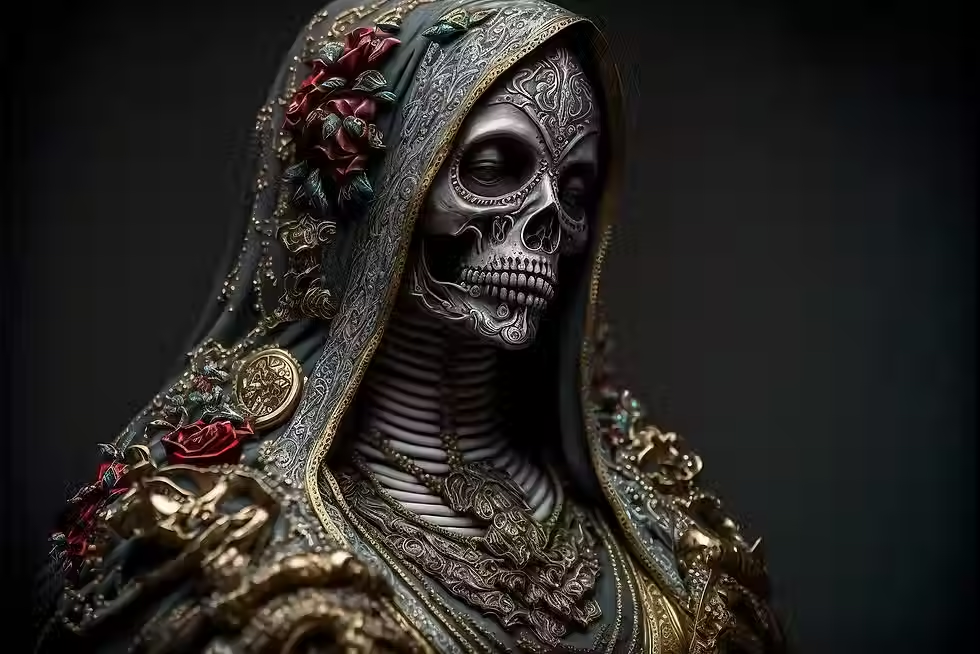
The growing visibility of Santa Muerte devotion, for example, illustrates how belief systems develop alongside social instability, political distrust, and spiritual hunger. What begins at the margins can become culturally significant.
Exploring this phenomenon in fiction is not about sensationalism. It is about understanding how devotion forms, spreads, and becomes embedded in identity.
Shrines appear. Symbols are worn publicly. Ritual becomes routine. What once felt peripheral begins to feel ordinary. And ordinary belief can be the most powerful kind.
The Subtlety of Conviction
Belief-driven movements rarely look extreme from within. They look structured. Purposeful. Even compassionate.
Language feels measured. The logic appears internally consistent. For those inside the framework, the system provides coherence in a fragmented world.
That is where tension in these stories truly lies, not in spectacle, but in recognition.
The unsettling element is not chaos. It is plausible.
Why These Stories Endure
Readers return to religious thrillers not simply for mystery or conspiracy, but because they explore something deeper: the intersection of faith, power, and human nature.
These stories examine:
How institutions preserve authority
How symbols shape behavior
How belief can both anchor and destabilize societies
How easily certainty can eclipse humility
They do not argue against faith. They interrogate what happens when belief becomes untethered from accountability.
That tension, between conviction and control is where the most enduring stories live.
It is also the terrain explored in The Death Saint and The Shadow of the Vatican series: a world where prophecy is not spectacle, faith is not caricature, and belief always carries consequence.
Banner Image Source: Freepik.com


Comments