
Dark Secrets, Ancient Prophecy, and the Cost of Knowing
Every relic carries a history. Every prophecy carries a warning. Some truths survive not because they are protected, but because revealing them would destabilize the systems built around them. In stories that explore the intersection of faith, power, and belief, ancient doctrines and modern ambition collide in ways that feel unsettlingly plausible. The boundary between devotion and control blurs, and discovery becomes less about adventure than consequence.

From the Vatican’s hidden archives to the modern resurgence of Santa Muerte devotion, prophecy functions not as mythology, but as an active force shaping decisions, influencing institutions, and testing the people who encounter it.
The Shadow Behind the Relics
Relics are rarely dangerous because of what they are. They become dangerous because of what they imply. Across history, certain objects, manuscripts, and traditions have carried meanings that challenge institutional narratives. Writers and historians alike have long understood that relics can function as pressure points places where belief, authority, and fear intersect.
Those who study these artifacts confront more than historical questions. They confront systems that have learned to manage belief by controlling access to knowledge. Every discovery carries a cost, and not all truths are meant to be absorbed without consequence.
Ancient Prophecy and Its Modern Consequences
Prophecy is often misunderstood as prediction. In reality, it operates more like a warning system encoded across generations, shaped by interpretation, and vulnerable to manipulation.
When ancient prophecies encounter modern ambition, they do not remain static. They are reframed, exploited, and sometimes weaponized. History becomes a tool, belief becomes leverage, and meaning itself becomes contested ground.
This tension between guidance and control sits at the heart of many modern religious thrillers books, where the danger lies not in the prophecy itself, but in who claims authority over its interpretation.
Santa Muerte and the Logic of Devotion
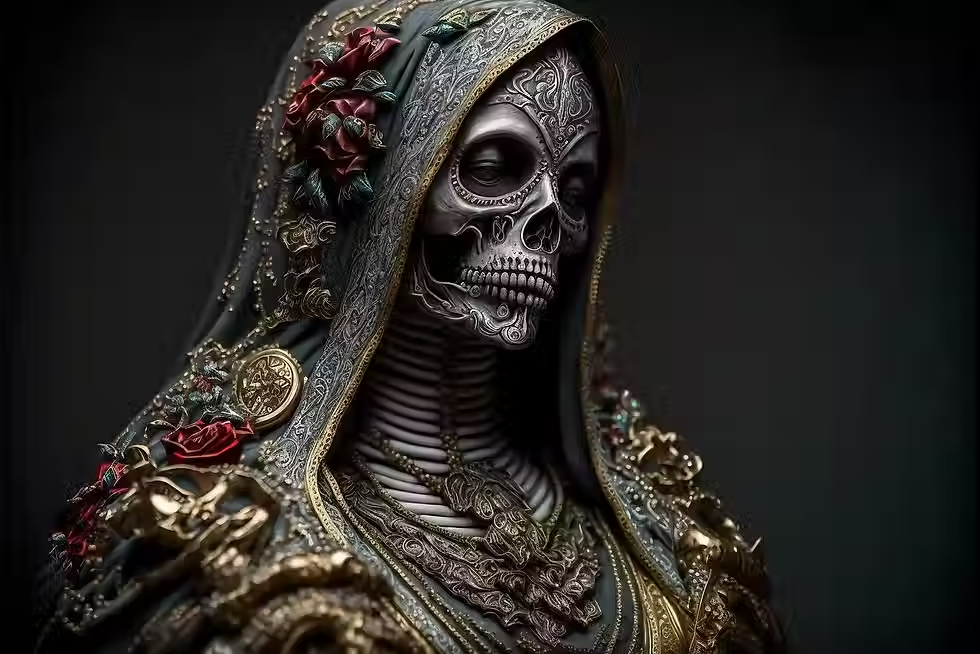
The rise of Santa Muerte offers a contemporary example of belief functioning outside traditional institutional structures. Neither purely folklore nor formally sanctioned, devotion to the “death saint” has grown through public shrines, private rituals, and a shared sense of protection and justice among her followers. Candles, amulets, and altars serve not as symbols of rebellion, but of personal agency in a world perceived as hostile or indifferent.
In fiction that treats this movement seriously, Santa Muerte is not sensationalized. She becomes a lens through which to explore how belief spreads, how loyalty forms, and how spiritual authority can exist without intermediaries.
Research, Revelation, and Risk
Engaging deeply with suppressed history and alternative belief systems carries risk — not because the knowledge is inherently forbidden, but because it disrupts established narratives.
Researchers and writers who trace these threads encounter resistance, not always overt, but structural. Institutions rarely respond well to questions that destabilize their foundations.
For readers, following these investigations offers something rarer than excitement: an invitation to sit with uncertainty, to recognize that knowledge can be both illuminating and destabilizing.
Beyond Adventure: Why These Stories Endure
What distinguishes these thrillers is not spectacle, but restraint. They do not rely on constant action, but on accumulated pressure the slow realization that belief itself can be shaped, redirected, and exploited.
By grounding suspense in real theology, documented history, and contemporary movements, these stories invite readers to think as much as they react. The result is not escapism, but engagement.
Begin the Journey
The Death Saint opens a story shaped by devotion, suppressed knowledge, and the uneasy space where faith and power intersect. Through historical investigation, modern religious movements, and ancient warnings, the novel offers a thriller that values consequence over spectacle. For readers drawn to Vatican history, prophecy, and the modern resurgence of belief outside institutional boundaries, it is an entry point into a world where truth is never neutral and never free.
Banner Image: freepik.com


Comments