
Prophecies that Inspired the Series - Part 1
Updated: Dec 14, 2025

When readers step into The Shadow of the Vatican series, they enter a world shaped not only by supernatural conflict and thriller pacing, but by real prophecies—warnings and visions that have echoed across centuries, cultures, and belief systems.
The series is fiction.
The prophecies behind it are very real.
As I researched The Death Saint, The Lost Wisdom, and The Prophets’ War, I kept encountering the same unsettling pattern: radically different traditions pointing toward the same fears—deception, corrupted authority, false signs, and a final spiritual conflict that does not remain confined to the unseen world.
This article explores the primary prophetic sources—biblical, Catholic, Gnostic, indigenous, and modern—that shaped the characters, themes, and mythology of The Shadow of the Vatican.
1. The Prophecy of the Two Witnesses (Revelation 11)
Source: The Book of Revelation
Theme: A spiritual war erupting into the physical world
Series Connection: Nathaniel and Alexandria
Revelation speaks of two prophetic figures who appear near the end of the age—empowered, opposed, hunted, silenced, and ultimately vindicated before the world.
The Shadow of the Vatican does not retell Revelation. But it draws deeply from its structure:
chosen figures who do not seek their role
a world unable to discern truth from deception
a conflict where spiritual authority becomes public and political
Nathaniel’s impossible intuition and Alexandria’s connection to death reflect this ancient duality. Both are marked. Both are hunted. Both become symbols in a war far larger than themselves.
In this series, prophecy is not a riddle.
It is a weapon.
2. Marian Prophecies and the Warning of Apostasy
Sources: Fatima, Akita, La Salette
Theme: A divided Church and spiritual deception
Series Connection: The Prophets’ War
Catholic prophetic tradition repeatedly warns of a coming crisis marked by:
corruption within the hierarchy
false signs that deceive even the faithful
a great trial centered on Rome
These warnings—some approved, some controversial, all unsettling—form the backbone of The Prophets’ War. The idea of an “apostate Rome” is not modern invention. It is centuries old.
What unsettled me most in researching these prophecies was how easily they adapt to modern forces: AI-driven persuasion, neural manipulation, mass psychology, and political pressure.
Ancient warnings colliding with modern capability create a perfect storm—one foreseen by mystics long before technologists.
3. Gnostic Prophecies Concerning Sophia (Wisdom)
Sources: Nag Hammadi texts, Pistis Sophia, The Gospel of Mary
Theme: Hidden knowledge and counterfeit divinity
Series Connection: The Lost Wisdom
In Gnostic thought, Sophia—Wisdom—is a cosmic figure tied to creation, knowledge, and loss. Gnostic writings warn of:
a return of hidden wisdom
false creators masquerading as divine
knowledge that can liberate or destroy
These ideas directly inform The Lost Wisdom, where Nathaniel’s journey through Europe forces him to confront an unsettling question:
Is the voice guiding him divine…or a counterfeit wearing God’s name?
The Gnostics warned of “the counterfeiter”—a being that appears holy, speaks truth mixed with lies, and draws followers through revelation rather than force. That warning remains disturbingly relevant.
4. Indigenous and Mesoamerican Prophecies of Death
Sources: Aztec cosmology, Santa Muerte folklore
Theme: Death as power, not ending
Series Connection: The Death Saint
Long before colonization, Mesoamerican cultures understood death as sacred, cyclical, and demanding. Death was not evil—but it was owed.
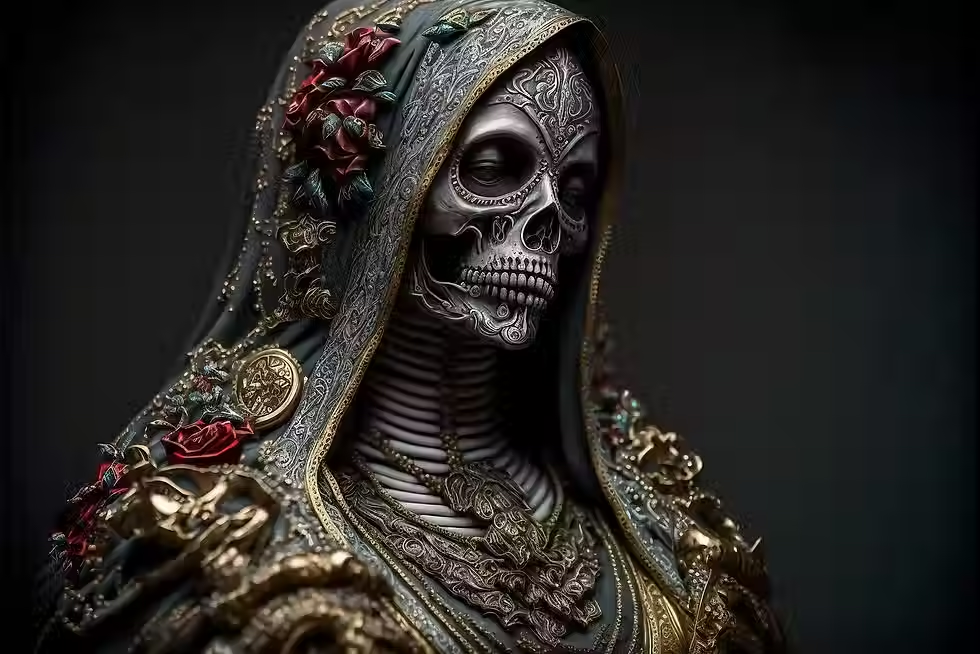
Modern devotion to Santa Muerte draws heavily from these ancient frameworks. In The Death Saint, this belief becomes weaponized.
The idea of “a girl who carries death inside her” is rooted in indigenous cosmology, where death remembers, claims, and collects.
When a warlord merges that belief with modern technology, the prophecy becomes global.
5. The Prophecy of the Great Deception
Sources: New Testament warnings, Church Fathers, apocalyptic mystics
Theme: A world unable to discern truth
Series Connection: Entire trilogy
Nearly every Christian tradition warns of a time when humanity will no longer distinguish between:
miracle and manipulation
prophet and predator
revelation and propaganda
This warning lies at the heart of the entire series.
The antagonists in The Shadow of the Vatican do not conquer by force alone. They rewrite memory, belief, and worship—engineering a deception so complete it feels supernatural even when it is manufactured.
The central question becomes unavoidable:
If deception becomes indistinguishable from divine truth, who will humanity follow?
6. A Final War Between Spirituals and Guardians
Sources: Composite mythological frameworks + original series lore
Theme: Spiritual evolution and responsibility
Series Connection: Series-wide mythology
This is the one prophetic framework unique to the series—but it is built on ancient patterns:
watchers and warriors
guides and corrupters
human destiny intertwined with unseen conflict
In the world of The Shadow of the Vatican, some are born sensitive to the unseen—spirituals. Others are born protectors—guardians.
Ancient traditions speak of a final convergence when both are awakened, tested, and divided.
Nathaniel and Alexandria stand at the center of that convergence.
7. A Modern Prophecy: Technology as the New Spiritual Battlefield
Sources: Neuroscience, AI ethics, cyber-psychology
Theme: Engineered belief
Series Connection: Series-wide escalation
Ancient religions warned of false signs.
Modern science has learned how to manufacture them.
Neural interfaces.
AI-generated voices.
Psychological conditioning.
Digital ritual.
In The Shadow of the Vatican, ancient prophecy does not fade—it adapts. Weaponized spirituality becomes scalable.
When ancient warnings meet modern manipulation, the result is not enlightenment.
It is control.
Why Prophecy Matters in the Series
In this trilogy, prophecy is not comfort.
It is warning.
It reveals not just what might happen—but what humanity is willing to believe when certainty disappears.
The prophecies behind The Shadow of the Vatican make the story feel both ancient and unsettlingly modern because they reflect real fears, real history, and real spiritual tension.
Want More Lore?
If you’re interested in the real theology, history, and supernatural research behind the novels, join the insider list.
You’ll receive exclusive lore, early chapters, and a free prequel novella:
The Shadow Archives, Volume I — The Birth of Shadows


Comments